Cybersecurity, MXDR

Accelerating Supply Chain Cyber Risk Reduction (Part 1)

Table of Contents

Today, I was with some manufacturing businesses who have recently experienced a significant increase in cyber activities, largely through their diverse supply chains. They had initially attempted to manage this themselves, but when the risks elevated, they sought external expertise. The principles of supply chain cybersecurity are definitely better understood in 2023, but the landscape is changing so rapidly it can be difficult to prioritise. So, what the most effective response for Supply Chain Cyber Risk Reduction?

Recommendations for Supply Chain Cyber Risk Reduction

My first recommendation is the excellent guidance provided by the NCSC embedded in these 12 principles. The NCSC divides the approach into 4 easy to implement stages of:

  1. Understanding the risk
  2. Establishing control
  3. Checking your arrangements
  4. Continuous improvement

We have worked with a lot of manufacturing and distribution businesses in 2023, as there has been a marked increase in nefarious activities in this sector. Our specialist partner, Dragos, recently completed their updated research that confirmed a 18% increase from the previous quarter in attacks. It is complicated by a number of factors, not least many of the affiliates are working closely together and providing aggregated intelligence and resources. Bottomline, cyber and supply chain risks are increasing. Significantly.

Understanding supply chain risk

The NCSC guidance starts with understanding risk, which focuses on:

  • Understanding what needs to be protected
  • Know your supplier security
  • Quantify the security risk posed by your supply chain

The most significant issue with this for many organisations is helping supply chain businesses understand and assess their own security maturity. There are useful approaches available like the NPSA questionnaire, but feedback has been one of poor or inconsistent responses as smaller business of 5 to 50 employees simply do not have time or skills to do this, particularly in the current climate. It is a fair challenge and something we are striving to improve. Without this, understanding the security risks posed by your supply chain can be very difficult. Or, if you take a no response/compliance view, you would rate some of your best suppliers as too high risk to work with. And that doesn’t work for anybody.

How to gain more control over your supply chain cyber risk

The NCSC guidance provides very clear insights into how you should seek to establish more control of your supply chain. This includes but is not limited to:

  • Communicating your view of security needs of your suppliers
  • Setting minimum security requirements of suppliers
  • Building security considerations into your contracting processes

So, by actually doing the first 6 principles together, setting realistic timelines to achieve this e.g. over the next 6 to 12 months, you will be able to reduce risks for both your business and your supplier. It is demonstrating how this can be achieved with minimal impact to all concerned that is most important up front to maximise engagement.

What I’ve tried to do about supply chain risk

Over 12 months ago, Jav and myself met with 2 manufacturing businesses leaders who expressed real concern at the absence of cyber industry solutions to the above problems. We responded by creating CloudGuard’s PROTECT Lite MXDR service. It is specifically designed for supply chain businesses of 5 to 50 employees, to help reduce key risks by embedding the above principles and enabling the NCSC principles I will discuss in my next blog on Supply Chain Cyber Risk Reduction.

What is MXDR? Read more

For more information on our PROTECT Lite MXDR service for supply chain partners, please reach out to [email protected] for more information or guidance. Together, we can reduce business risks from cyber disruption from today. Next week, I will talk about the second 6 principles in more detail. Thanks for reading.

Author: Matt Lovell
Share:
Author: Matt Lovell
Share:

Related Resources

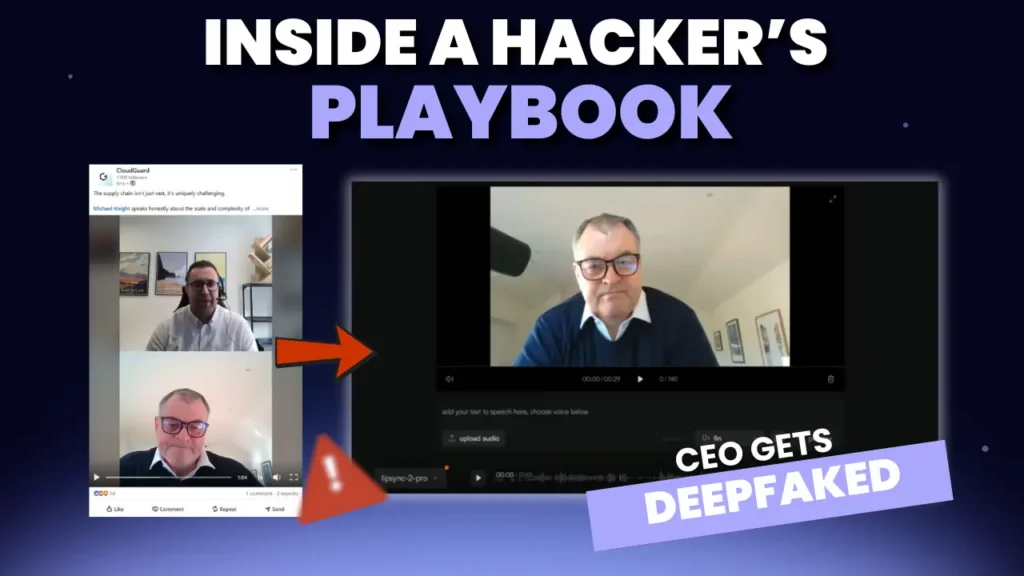
two men talking on a podcast posted on linkedin with a red arrow pointing towards a deepfake
Why Social Engineering Always Works: How Hackers Use Phishing & Deepfakes
We’ve all done the training, so why are attackers still getting through? Attackers no longer rely on bad spelling or suspicious links, they use AI-generated deepfakes and psychological profiling to manipulate people with astonishing precision. By exploiting the brain’s emergency response system, they trigger fear, urgency, or authority to override...
Dark purple background with claude logo and words pro, team and enterprise.
Claude Business Security: Choosing the Right Account for SMBs
When I shared my last article, a few people got in touch asking for a more practical follow-up, specifically around how small teams can use Claude Pro without putting business data at risk. This piece goes step by step through exactly that. Understand what you’re actually adopting Claude Pro is...
Two analysts looking surprised. Purple cyber background with phishing hook.
What Happens After a Phishing Attack? A Real Microsoft 365 Incident Walkthrough
If your organisation thinks a password reset or MFA alone are enough, think again. In this phishing attack breakdown by CloudGuard’s SOC team, Conor and Jon reveal the reality behind an actual breach involving a UK law firm, exposing how hackers use four methods to regain access long after initial...
purple background with computer that says threat from the field in cartoon like design
Cyber Threat Trends Q1 2026: Data Theft, AI Attacks and Emerging Risks
Executive Summary Every 90 days, we review the latest cyber threat trends to identify what IT leaders should learn, where resilience gaps are widening, and what practical actions organisations should take next.  The first quarter of 2026 has been intense. The UK threat picture is not defined by one single...
Microsoft Defender for Cloud
Microsoft Defender for Cloud Cloud environments change fast. New workloads, new services and new risks appear daily, often without full visibility or clear ownership. Microsoft Defender for Cloud provides continuous assessment across Azure, hybrid and multi-cloud environments to help organisations understand and reduce cloud security risk. CloudGuard ensures your cloud...
Woman looking at tablet with cyber imagery across the top.
The Limitations of External Penetration Testing (And What to Do About Them)
Core argument  Traditional internal penetration tests gives executives false confidence because it’s typically scope-limited, scheduled, doesn’t reflect real attacker behaviour and ignores the AI threats with user access. Would you feel comfortable boarding a plane if the pilot had practised emergency landings but had never actually simulated an engine failure?  So, why do businesses specifically exclude their...
CloudGuard logo and Stonewater Housing logo on a pastel purple background
Stonewater Housing Achieves 24/7 Security Monitoring Without Expanding Its IT Team
Image of man with half blue face on left and half red face on right. ÂŁ20 notes falling in the background.
Date | Time: 24/03/2026 | 12:00 pm
[On Demand] The AI-Enabled Insider Threat: When Trusted Access Becomes Competitive Advantage
Your most trusted employees can now distil years of institutional knowledge in days, sometimes without realising the risk they’re creating. Insider risk has fundamentally changed. We’re past the days of someone copying files onto a USB stick. Today, trusted employees are using AI tools to summarise reports, analyse strategy documents,...
Continuous Security Validation: How to Prove Your Cybersecurity Controls Actually Work
Core argument CISOs are increasingly measured not by the security they implement, but by the breaches they fail to prevent. Most cybersecurity investments create a false sense of protection because they’re never truly tested under realistic conditions.  Zero trust applied new controls but the new wave of Agentic AI solutions will fundamentally...
Get In Touch

Our Cybersecurity Services Can Instantly Improve Your Business’ Security Posture

Complete the form to find out more about any of our one-off or managed cybersecurity services. Not seeing what you’re looking for? Our cybersecurity consultants and MXDR experts are always on-hand to provide the guidance and support you need.