Measuring the effectiveness and return on investment (ROI) of your cybersecurity investment is important if you want to ensure you’re allocating business resources wisely and protecting your assets from potential threats.
To accurately gauge this, you must reassess your approach to risk evaluation, focusing on the likelihood of vulnerability exploitation and its potential impact.
If you’re reading this, then you’re looking at implementing automation into your cyber strategy.
We’re going to use this time to show you how you can measure the effectiveness and ROI of cybersecurity automation at a high level. We’ll also discuss how automation can save costs and help protect your business from new and changing threats.
Evaluating your business risk
Measuring the effectiveness of automation security relies on understanding your organisation’s unique objectives and risk landscape.
Risk is defined as the likelihood of something happening.
Many organisations slip up by spreading their cybersecurity objectives too thin, aiming to achieve numerous goals simultaneously. This approach can dilute effectiveness and make it harder to achieve a positive ROI.
There needs to be a shift in evaluating risk to achieve an effective cybersecurity posture.
How do we evaluate risk?
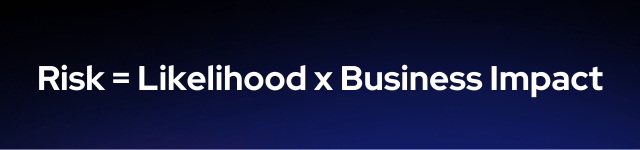
To evaluate risk, you need to look at the likelihood of a vulnerability being exploited within your ecosystem coupled with its potential impact.
By assessing risk through this lens, you can identify the effectiveness of your cybersecurity efforts more accurately.
With this knowledge you can:
- Understand how to apply investment
- How you then measure the return on that investment
We know that the attackers are using more AI and more automation themselves, so you must also use automation in order to detect and respond and combat these evolving threats successfully.
The effectiveness of investment directly correlates to both identifying the risk and accelerating automated response to that risk. That will be what reduces the impact to your business.
While some may argue that ROI in cybersecurity is intangible, we propose a different view.
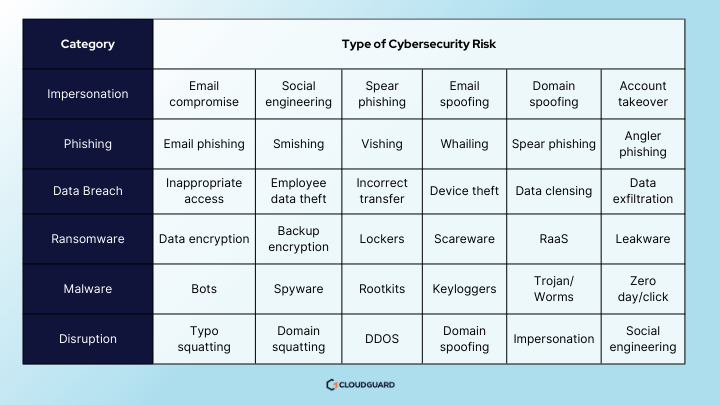
Measuring the impact of automation
By comparing the time taken for automated response versus manual intervention, you can quantify the potential impact of automation on your organisation’s performance.
What damage can happen to your business between detection and response?
That is your measure of effectiveness and therefore return on investment.
Let’s not forget that threat actors often infiltrate organisations discreetly, gathering intelligence to launch devastating attacks. They want to understand your business, your data and your assets, so they can exfiltrate and ransom accordingly before executing their attack.
Automation not only accelerates threat detection but also mitigates the following impact.
Essentially, the effectiveness and ROI of cybersecurity automation investments for Small and Medium Size Enterprises (SME’s) lie in their ability to proactively identify and neutralise threats, minimising potential damages and operational disruptions.
Potential cost savings associated with cybersecurity automation
Building upon the previous insights, these potential cost savings are twofold.
Firstly, there are cost savings at a risk level. By continually improving your cybersecurity posture through automation, you can effectively identify and address vulnerabilities in your technology environment.
Whether the remediation phase is automated or manual, the key takeaway is that automation helps you mitigate risks more efficiently.
Taking this a step further, let us consider the speed of response that automation provides you versus manual intervention.
The first 48 hours following an attack are the most critical.
Matt Lovell, CloudGuard, CEO
Automation enables you to react quickly and decisively. By being able to protect your business within 60 minutes of detecting an issue, you significantly reduce the window of opportunity for attackers to exploit vulnerabilities.
If a threat were to go undetected or unattended for hours, the potential for a cyber-attack with substantial impact and cost to the business becomes alarmingly high.
The ability of cybersecurity automation to identify, alert, and resolve security incidents in a timely manner translates into tangible cost savings by preventing potential financial losses and reputational damage.
To put this into perspective, business can lose on average 7.5% of their stock value following a cyber incident.
In 2023, Okta lost $2 billion of their market valuation the week following the announcement of their breach. This goes to show the influence that cybersecurity incidents can have on a company’s financial standing and market perception.
Calculating cybersecurity automation ROI
It’s time to put everything we said into perspective so you can picture things for your business.
We are going to use a basic formula to help you understand how to calculate the return on your cybersecurity automation investment.
Most businesses compare the gain or loss from an investment relative to the cost of the investment over a given period.
Whilst you can estimate the likely cost of a given cyber security incident and multiply this by the expected frequency based on industry data, this remains a somewhat abstract approach as there is no standard framework for classifying risks.
One commonly adopted approach made popular by the former US Secretary of Defence Donald Rumsfeld is the Known and Unknown framework.
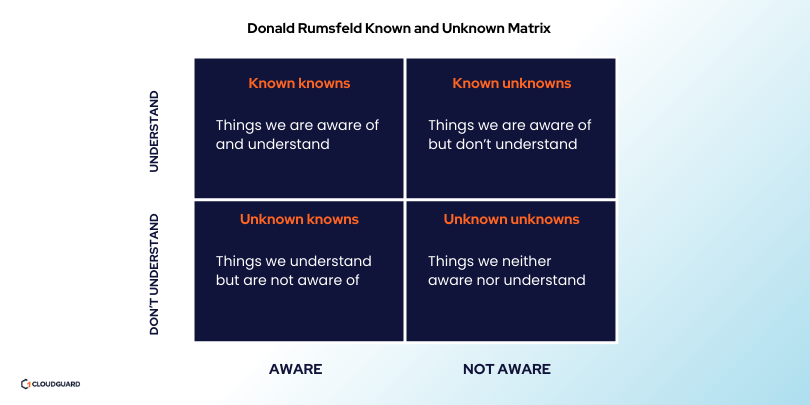
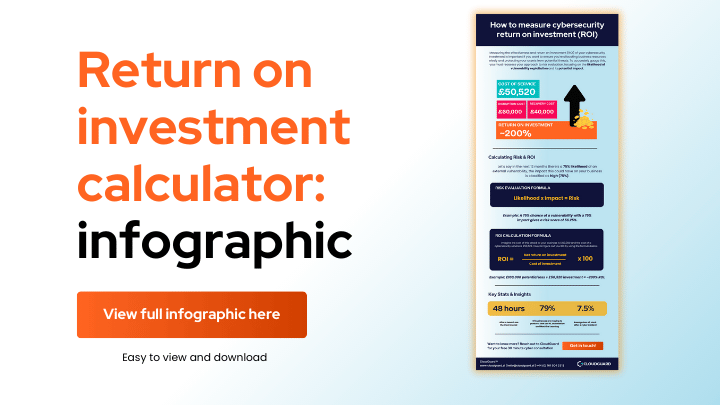
Let’s say in the next 12 months there’s a 75% likelihood of an external vulnerability, the impact this could have on your business is classified as high (75%).
Likelihood (7.5) x Impact (7.5) = Risk (56.25%)
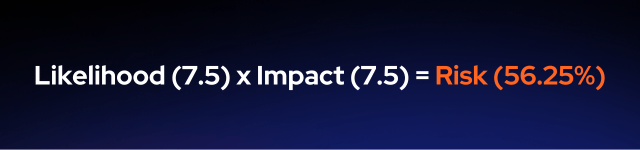
The likelihood of an attack like this happening is over 50%, which means you are taking your chances if you don’t invest in protecting your business.
Now let’s weave ROI into the equation.
Imagine the cost of this attack to your business is £100,000 and the cost of a cybersecurity service is £50,000.
You can figure out you ROI by using the formula below.

Cost of being exploited (£100,000) ÷ Cost of cybersecurity service (£50,000) = Return on Investment (2)
£100,000 ÷ £50,000 = 2 x 100
ROI = 200%
Your return on investment for investing in a cybersecurity product is going to be 200%.
Want to got a step further?
Deploying a SIEM solution can further improve your ROI. The greater the volume of information aggregated from your SIEM, the more informed decisions can be made to protect your business and subsequently, your ROI.
There are many variables you need to consider when calculating a return on investment for any cybersecurity solution.
No solution will guarantee 100% protection from all threats – existing, modified, new or emerging.
Prevention is the best approach and most solutions, with appropriate management, will significantly reduce business risk.
Time remains the key factor in minimising disruption, loss and business risk. Time to detect, mitigate, intervene, respond and resolve relies on automated-led approaches. The perpetrators are using automation at scale and the only effective response can be a corresponding automated approach.
Conclusion
There you have it, a dive into the world of cybersecurity automation investment and ROI assessment.
We’ve walked through the steps to measuring cybersecurity automation’s effectiveness, stressing the importance of quick threat response and risk evaluation.
From potential cost savings to reputation preservation, the benefits of proactive cybersecurity investment for your business are clear. Let’s not forget the crucial role of calculating ROI to ensure you are measuring the value of your cybersecurity investments.
With these insights, we hope you’re equipped to make informed decisions to protect your business and maximise your cybersecurity ROI.
At CloudGuard, we want businesses to continually improve their cybersecurity posture. If you need help building a business case for investing in automation, or have general cyebrsecurity concerns, we’re here to help. Book yourself a free cybersecurity consultation here.