If a supplier assurance questionnaire has landed in your inbox recently, you’re not alone. Big organisations are asking their suppliers more questions, more often, and a certificate and a few ticked boxes no longer cut it.
To find out what buyers are really looking for, we asked someone who both sends these questionnaires and answers them. Cara Walker is Global CTO at adm Indicia, a global brand activation agency.
She works with more than 2,000 suppliers, and her clients include some of the world’s biggest brands, so she sees supply chain security from both sides.
In this article, you’ll find out what buyers actually check, what gets suppliers dropped, and how to answer your first questionnaire with confidence. You’ll also see why the Cyber Security and Resilience Bill matters even if your business isn’t directly in scope, and how to stay ahead of what your customers will expect.
Why are buyers asking more cybersecurity questions now?
Buyers are sending more supplier assurance questionnaires because a supplier’s breach can now stop their business.
Recent attacks have shown how far the damage spreads, the NCSC expects incidents to rise, and new regulation is raising the bar on supply chain security. Large organisations are now checking suppliers they once trusted by default.
The clearest example is the 2025 attack on Jaguar Land Rover. The Cyber Monitoring Centre estimated it cost the UK economy around £1.9 billion and affected more than 5,000 organisations, many of them in JLR’s supply chain. It showed buyers that their own security counts for little if a supplier gets hit. Large manufacturers in particular are now checking their suppliers far more closely.
Most businesses still don’t look closely at their suppliers. The government’s Cyber Security Breaches Survey 2025/26 found only 15% of UK businesses review cyber risks from their immediate suppliers, but 48% of large businesses do.
Those large businesses are your customers, and as they tighten up, the questions flow down to you.
The pressure is growing. In November 2026, NCSC chief executive Richard Horne warned of “a real prospect of an unprecedented rise in the number of cyber incidents”. The Cyber Security and Resilience Bill will also put stronger security and reporting duties on the organisations it regulates.
Even if your business isn’t in scope, your customers may be, and their questionnaire is how those expectations reach you.
What has changed in supplier assurance questionnaires?
Supplier assurance questionnaires now cover more ground and arrive more often. Buyers want to know how you control AI, they expect answers between annual reviews, and they send questionnaires to every supplier, not just technology firms.
Above all, a certificate is no longer enough. Buyers want evidence that your controls work in practice.
AI and agentic tools are now near the top of the list
AI is the biggest new topic in supplier questionnaires. As businesses adopt AI agents that can carry out tasks on their own, buyers want to know which tools their suppliers use, what data those tools can reach and how they’re controlled. Many aren’t waiting to be asked. Cara says clients are coming to adm Indicia early with questions about AI, so her team now explains its approach proactively.
What this means for you: be ready to explain which AI tools your team uses, what data they can access and how you control them. If you don’t have an AI use policy yet, start there.
An AI security health check can show you where the gaps are.
Buyers no longer wait for the annual questionnaire
Security reviews used to happen once a year.
Now buyers ask whenever something happens. When the PHP2Shell vulnerability hit in October 2026, buyers wanted to know their exposure, which versions were in use and who was managing the incident, within hours.
“Almost instantly, 90% of our customers were asking pretty much the same questions.” Cara Walker, Global CTO, adm Indicia
What this means for you: treat your answers as a living document. Keep your evidence up to date so you can respond within hours, not weeks, when a customer asks out of the blue.
Every supplier gets one, not just technology suppliers
Detailed security questions used to be reserved for suppliers providing technology services. Now buyers send much the same questions to almost every supplier, from professional services firms to law firms, and Cara expects that to keep increasing.
What this means for you: don’t assume you’re too small or too “non-tech” to be asked. If you handle a client’s data or connect to their systems, expect the full questionnaire, whether you supply marketing, logistics or professional services.
ISO 27001 or SOC 2 alone no longer ticks the box
Certifications still matter, but they’re now the starting point.
A couple of years ago, ISO 27001 or SOC 2 would have satisfied most buyers. Now they want proof that the system behind the certificate is working, tested and improving.
“You may have the management system, but I want to see more evidence of how you’re applying that management system.” Cara Walker, Global CTO, adm Indicia
What this means for you: keep records that show your controls in action, such as test results, patching logs and notes from incident exercises. The same goes for Cyber Essentials. The certificate gets you in the door, but evidence keeps you there.
Less tolerance for legacy technology, even with other controls in place
Every business has old systems. What’s changing is how long buyers will accept them.
A year ago, putting an old system on the risk register, adding protective controls around it and planning to retire it within six months was a reasonable call. Now attackers move faster using AI, and buyers expect suppliers to keep up.
As Cara puts it, the pace of exploitation “will drive us to having to be constantly upgrading.”
What this means for you: know what legacy technology you’re running and have a dated plan to upgrade or replace it. “We’re keeping an eye on it” won’t reassure a buyer for long.
Expect questions about your own suppliers
The next step is your supply chain. Buyers increasingly want to know who you rely on to deliver for them, from cloud platforms and software to subcontractors. Cara expects these questions to grow as buyers look further down the chain.
What this means for you: map the suppliers behind your service and know what security they have in place. If a customer’s requirements are strict, you may need to pass them down to your own suppliers too.
Why do suppliers fail a supplier security questionnaire or get dropped?
Most suppliers fail for avoidable reasons. They can’t show the accreditations a buyer asks for, they assume security only matters for personal data, or they let standards slip once they’ve signed.
Buyers also drop suppliers that don’t pass security requirements down their own supply chain, or can’t show a tested incident response plan.
They don’t get past the first gate
Many buyers set minimum accreditations before they’ll even have a conversation. Just before our session, Cara had turned away a prospective supplier for exactly that reason. Find out what your target customers require before you pitch, not after.
They think only personal data matters
GDPR made everyone focus on protecting personal information, and many businesses now assume that’s the only data that counts. The supplier Cara turned away asked why the checks were needed when the work was “just” marketing.
“That doesn’t mean that that control needs to be any less for any type of data or any type of environment.”
Cara Walker, Global CTO, adm Indicia
Buyers expect the right controls whatever data you handle.
They treat vetting as a one-off
Passing the questionnaire once isn’t the finish line. Buyers audit suppliers over time, and if a certification lapses or a control disappears, they’ll want to know why.
They don’t pass obligations down the chain
Buyers have to meet their own clients’ requirements, and they expect suppliers to do the same. Rather than tailoring controls client by client, Cara’s team works to the most stringent requirements it has, and checks that its suppliers can meet them too.
Nobody clearly owns the incident response plan
Buyers want to know who owns your plan, who manages an incident and how often you test it. “We’ve got a plan somewhere” won’t pass.
The good news is that buyers scale their checks to the risk. A supplier delivering office stationery won’t face the same scrutiny as one running critical business systems. What matters is showing the right controls for the work you do.
How should a small business answer its first security questionnaire?
Answer honestly, even where the answer is “not yet”.
Buyers would rather see a clear gap with a plan to fix it than a confident “yes” you can’t back up. Treat the questionnaire as a free guide to what customers will expect from you, and get outside help if you need it.
Don’t panic. A long questionnaire can feel daunting the first time. Most buyers know a small supplier won’t have every control an enterprise has. What they want to see is that you understand your risks and are in control of them.
Be completely honest. It’s tempting to round a “partly” up to a “yes”, but don’t.
“There’s no grey areas here, so you can’t afford to try and play in a grey area.”
Cara Walker, Global CTO, adm Indicia
Your answers can end up in your contract, so overclaiming can come back to bite you if something goes wrong. If a control is only partly in place, say so and explain what’s planned.
Use your gaps as a benchmark. Every question you can’t answer yet shows you what customers will expect next. Turn those gaps into a plan with owners and dates. You’ll be better prepared for the next questionnaire, and for the requirements the Cyber Security and Resilience Bill is likely to push down supply chains.
Get an outside view. If you don’t have a security partner, independent advice can help you close gaps faster and answer with confidence. A Security Posture Assessment is a good starting point, showing where you stand against what buyers now expect.
What evidence should you have ready?
Buyers want proof, period.
Before your next questionnaire arrives, pull together a simple evidence pack: your certifications, a map of your systems and suppliers, proof of MFA and patching, a tested incident response plan and details of how your systems are monitored.
CloudGuard’s CEO, Matt Lovell, who has 35 years’ experience in cybersecurity suggests allowing at least six months to build it properly.
Your evidence pack should include:
- Certifications: Cyber Essentials or Cyber Essentials Plus, ISO 27001 and any others you hold, with renewal dates.
- An asset and supplier map: your critical systems, the software, cloud and AI tools you rely on, and the suppliers behind them.
- MFA everywhere: with phishing-resistant MFA for admin and other privileged accounts.
- Patching records: showing how quickly you apply critical updates, not just that you do.
- A tested incident response plan: with named owners and notes from your last exercise. The NCSC’s incident management guidance is a useful place to start, or get help with incident response planning.
- Monitoring: who watches your systems, including evenings and weekends, for example through 24/7 managed detection and response.
- Independent assurance: recent penetration test results, a purple team exercise or an external review.
The incident response plan is where many suppliers fall short.
“Not just write an incident response plan. Test it, test it, retest it, learn from it.”
Matt Lovell, CEO, CloudGuard
Does the Cyber Security and Resilience Bill change what buyers will ask?
Yes, but for most small businesses the change will come through their customers rather than directly.
The Bill mainly regulates essential services, digital service providers, data centres and medium and large managed service providers. If your customers are in scope, expect their questionnaires to tighten as they work to meet new duties.
The Bill completed its House of Lords stages on 2 November 2026 and has returned to the Commons for MPs to consider the Lords’ changes. Royal Assent is expected between late 2026 and spring 2027, but most duties will be switched on later through regulations, expected around 2028.
For organisations in scope, the headline duty is incident reporting: an initial notification to the regulator within 24 hours and a full report within 72 hours. Regulated IT providers will also have to tell affected customers. Buyers working to those deadlines are likely to expect fast answers from their suppliers too.
Cara’s view is that the timeline doesn’t change much. Good buyers are already asking these questions.
Be ready before they ask
Supplier assurance questionnaires are becoming more frequent, more detailed and harder to pass with a certificate alone. The suppliers that win and keep contracts will be the ones who can prove their security, not just describe it.
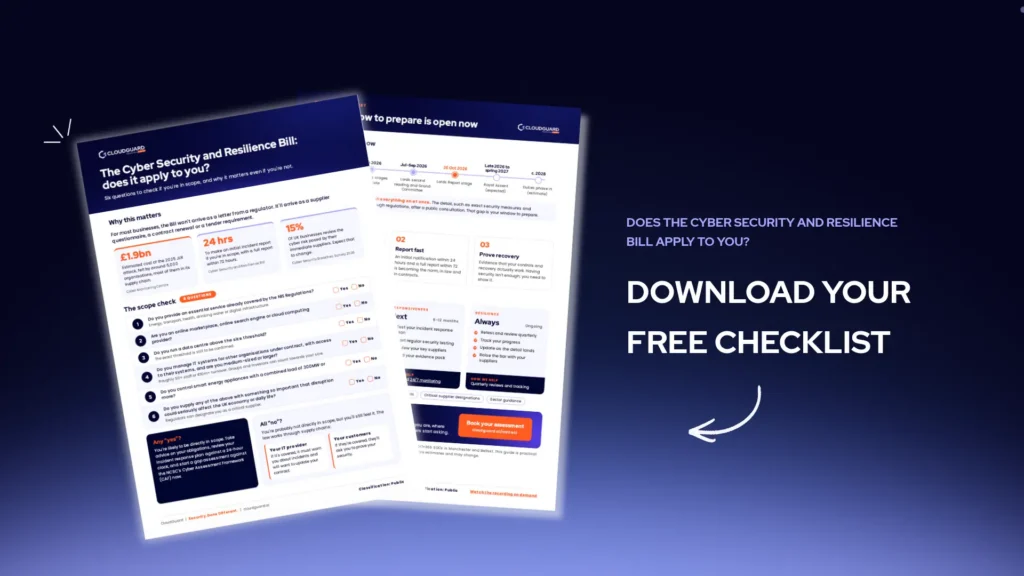
Watch the full conversation with Cara and Matt in our LinkedIn Live recording, and download our Cyber Security and Resilience Checklist to check whether the Bill applies to you. If you’d like an outside view of your security posture or supply chain risk, talk to our team.
About CloudGuard
CloudGuard is a UK-based managed security provider specialising in Microsoft security. From 24/7 security operations centres in Manchester and Belfast, we help small and mid-sized businesses detect and respond to threats, close security gaps and prove their resilience to customers. Our security operations centre is CREST accredited, and CloudGuard is Cyber Essentials Plus and ISO 27001 certified.
This article is for general information only and isn’t legal advice. The Cyber Security and Resilience Bill is still going through Parliament, and details may change before it becomes law. Correct as of November 2026. For advice on your specific obligations, speak to a qualified legal adviser.