You wouldn’t insure half your office. So why leave half your business unprotected from cyber threats?
50% of UK businesses were hit by cyber-attacks in 2024, costing medium-sized firms an average of £10,830 each time. Yet most of these losses were avoidable. In fact, 97% of successful attacks could have been prevented with better cybersecurity.
So how can you assess if your cybersecurity investment is truly worth it? The answer lies in calculating your cyber risk reduction.
This post explores how to do that, using insights from CloudGuard’s 2025 Cybersecurity ROI Business Case.
What is cyber risk reduction and why it matters
You know that cybersecurity is more than a technical concern, it’s a strategic business issue. Attacks disrupt operations, damage customer trust, and hit your bottom line.
Real-world example: When a UK-based SME in financial services suffered a phishing attack, their portal was down for 9 days. They lost two major clients and took a £200,000 reputational hit. Had they tested their incident response plan, they could have recovered in just 5 days and saved over £170,000.
The stakes:
- 53% of businesses suffer reputational damage after a breach
- 24% experience long-term financial losses not covered by insurance
- Market value can drop 14% in two weeks post-attack
Despite this, cybersecurity budgets in 2024 remained flat. Most SMEs are maintaining, not scaling, their defences. That’s a risk.
Cybersecurity ROI: The stats every CFO needs to see
The basic risk formula is:
Risk = Likelihood × Business Impact
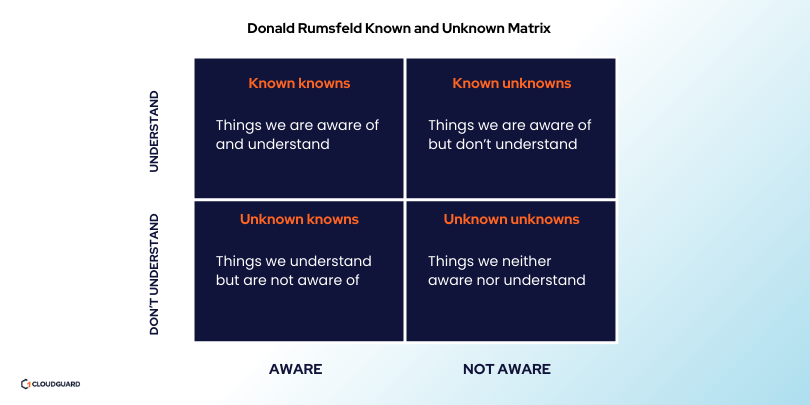
But CloudGuard goes deeper, classifying risks into:
- Known Knowns – predictable, measurable risks
- Known Unknowns – known risks with unclear probabilities
- Unknown Knowns – ignored or underestimated risks
- Unknown Unknowns – emergent threats like zero-days
Inspired by Donald Rumsfeld’s framework, the “Known and Unknown Matrix” helps businesses categorise cyber risks based on their awareness and understanding, ranging from clearly defined threats to unforeseeable vulnerabilities that emerge without warning.
CloudGuard also identifies key risk areas:
- People: Human error is the top vulnerability. From phishing scams to poor password hygiene, employees are often the first point of failure in a cyber incident. Ongoing training and a culture of security awareness are critical.
- Processes: Impersonation and workflow gaps allow attackers to exploit weak verification steps or lack of oversight in digital transactions. Businesses need clearly defined, secure workflows—especially in finance, procurement, and HR.
- Systems: Inadequate data classification & access controls lead to unmonitored exposure of sensitive information. A structured approach to data governance, including encryption and strict role-based access, is essential.
- External: Supply chain attacks surged 300% in 2023. Vendors, partners, and third-party services must be held to the same security standards, with contracts including cybersecurity clauses and periodic audits.
The true cost of doing nothing
67% of UK small businesses feel they do not have the in-house skills to manage cybersecurity issues.
Here’s what happens when cyber risk is ignored:
- 61% of SMEs fail within 6 months of a cyber incident
- Only 57% of UK SMEs have cyber insurance
- Average downtime: 12 days x £2,949/day = £35,388
- Tested IR plans reduce downtime by 45%
Even with cyber insurance, many claims fail due to gaps in security posture or untested Incident Response Plans. Check out cybersecurity for small business.

Risk reduction ROI: The numbers that matter
Using CloudGuard’s risk calculator:
- Average incident exposure: £506,000
- Likelihood of attack without investment: 38%
- Likelihood with investment: 8%
- Risk reduction: 30% = £151,800
Cost scenarios (150-employee SME):
| Investment Option | Cost | ROI (%) | ROI vs Managed |
|---|---|---|---|
| Managed Service | £41,949 | 261.8% | Best ROI |
| Internal Recruitment | £63,073 | 140.5% | 46% lower |
| External Recruitment | £95,927 | 58.2% | 78% lower |
A managed service model offers the highest ROI with the lowest complexity.
Phishing, downtime and reputational risk
Phishing is still the most common threat, accounting for 83% of cyber attacks.
This prevalence is due to the human element, it only takes one employee clicking a malicious link to compromise an entire organisation. The cost ripples into customer trust, operational continuity and even market valuation.
Successful cyber strategies account for this by addressing both technical safeguards and human behaviour. A layered approach builds resilience across every level of the business:
- Cyber training every 6 months to refresh awareness and recognise evolving tactics
- Formal, tested incident response (IR) plans to reduce recovery time and regulatory exposure
- SaaS account audits to revoke access for all leavers and reduce the risk of insider threats
- AI-enhanced detection systems that provide real-time alerts and automate first-response actions
A strong response posture consists of minimising impact, rapid detection, coordinated containment and informed response. These are the pillars that determine whether a cyber incident is a hiccup or a headline.
Want to know your own risk profile?
The question isn’t if you’ll face a cyber incident, it’s when. The only real question is: how prepared will you be?
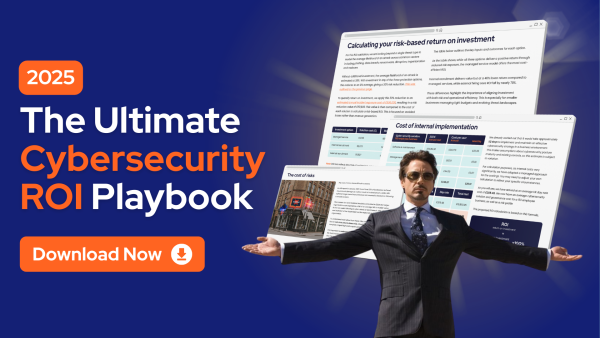
Download the full CloudGuard Cybersecurity ROI Business Case Guide to:
- Build your own risk model
- Calculate your risk-based ROI
- Access templates and planning frameworks
- Benchmark your cybersecurity maturity
Or reach out for a no-obligation consultation with CloudGuard experts.