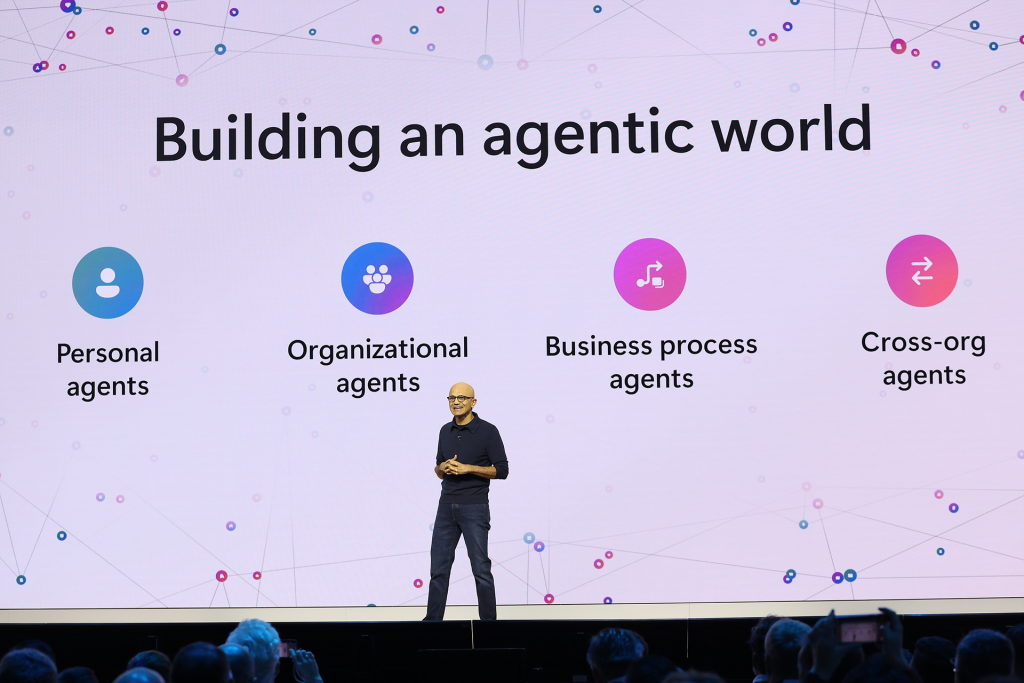
If you work in IT or security, Cybersecurity Awareness Month probably looks familiar. Every webinar invite, every vendor email, every stand at every event is selling some version of the agentic Security Operations Center (SOC). Autonomous. Self-healing. An AI analyst that never sleeps.
At CloudGuard, a UK-based Microsoft Security specialist and managed security service provider (MSSP) for SMBs across the UK, Ireland and Europe, we’ve been running automation and agentic AI on real security incidents for years. That experience has taught us that the gap between how this technology is sold and how it should be run is wide, and it’s worth saying out loud.
A rushed vendor evaluation process doesn’t just risk buying the wrong tool, it risks inheriting a costly compliance gap you didn’t know you’d signed up for.
Agentic doesn’t have to mean unsupervised. In security, it shouldn’t.
What is an agentic SOC, and who supervises it?
That’s the case for agentic AI. Without the hype, “agentic” means something fairly simple. It’s an AI that can plan a sequence of steps, use tools and work towards a goal, instead of answering one prompt and stopping. In a SOC that’s very useful.
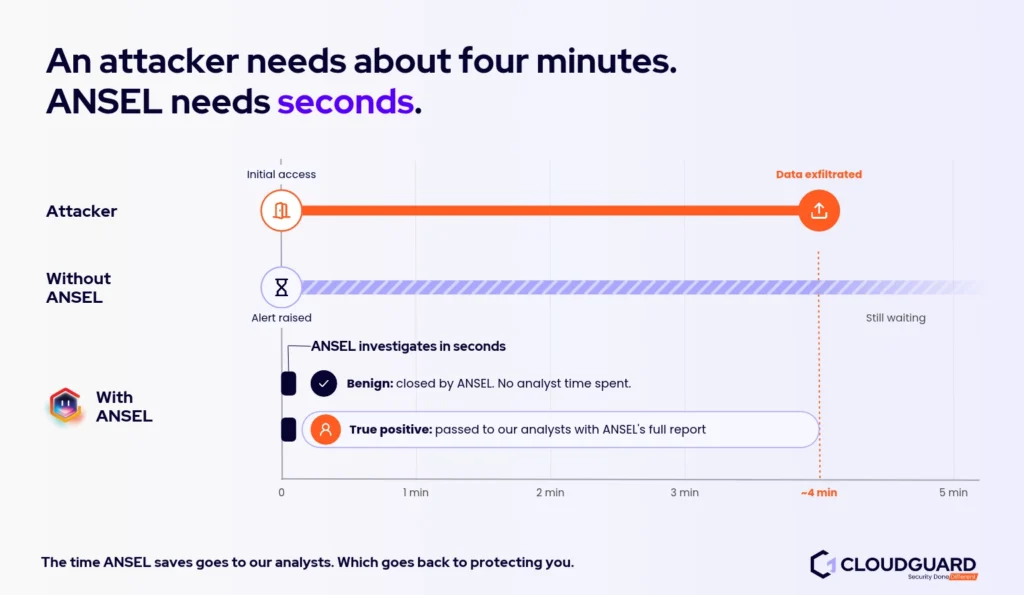
A fleet of agents can pull an alert’s history, write and run its own queries, run some SOC playbooks and tools and check what else is happening around it and reach a view in the time it takes a person to open the ticket. Seconds, not minutes or hours.
The trouble is that the market has quietly merged two different ideas.
Autonomy is about what an AI is capable of doing. Supervision is about who decides what it’s allowed to do.
You can have plenty of the first and still keep a firm grip on the second. Much of the current hype comes from vendors who talk endlessly about capability and say very little about control and governance.
Control matters because the biggest AI risks in security aren’t just rogue machines. They’re ordinary mistakes that can happen to anyone.
Sensitive incident data pasted into a tool nobody vetted. Confidential data being passed in and out of platforms with no visibility. A system rebooted before the forensic evidence was preserved. An agent given far more access than its job needs. A confident report that nobody checked.
Anyone can build an agent now. Building one that is secure, compliant and understands your environment is a different job entirely.
The noise problem lives inside the SOC too
In Q3 2026, roughly 1 in every 440 tickets that came through CloudGuard’s SOC was a true positive.
This is not unusual. The average business with Security Information and Event Management (SIEM) receives 2,992 security alerts a day, and an analyst can properly work through around 150 of them (Vectra AI, 2026). 71% of SOC analysts report burnout, and annual SOC turnover runs at 28% (UnderDefense, 2026).
The ways teams cope are predictable: suppression rules for noisy alert types, skimming by severity, trusting the platform’s own score. Each of those is a blind spot an attacker can sit in.
That’s the real case for agentic AI. Without it, analysts work through thousands of alerts by hand, and almost every one turns out to be nothing. Hour after hour of false alarms wears people down. Tired people start skimming, and the one alert that matters can look exactly like the hundred before it.
In a SOC, that missed alert is the difference between a contained incident and a breach. ANSEL clears the benign noise first, so our analysts spend their time on threats that need a human in the loop.
What is ANSEL?
ANSEL is CloudGuard’s agentic SOC engine, built natively on Microsoft Azure. Our analysts work alongside ANSEL to monitor your environment 24×7×365. Today, ANSEL’s agent fleet triages and investigates incidents the way an analyst would.
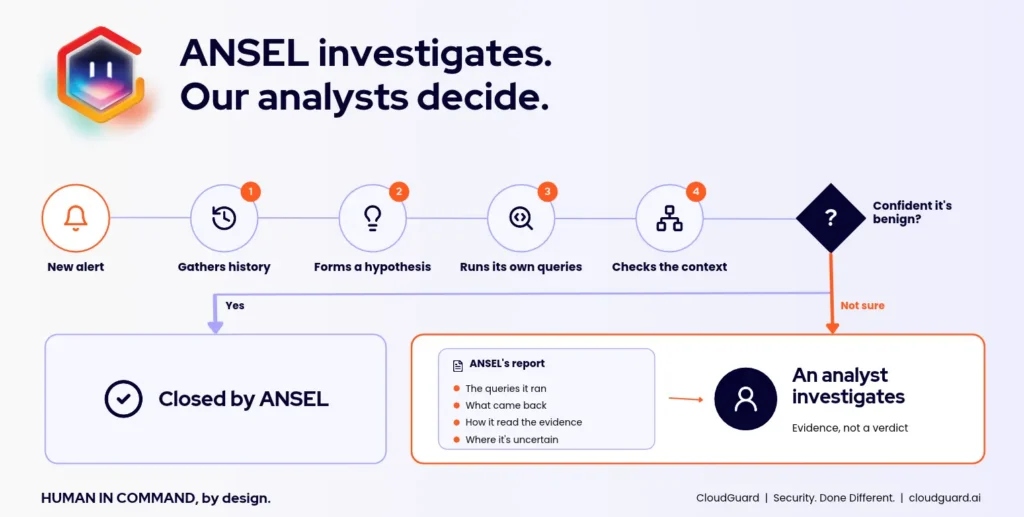
Each agent gathers history, forms a hypothesis, and writes and runs its own detection queries in real time. And it checks the surrounding context every time, where a person under pressure might stop once they have enough to go on.
If ANSEL is confident something is benign, it closes it. If it isn’t sure, or something looks wrong, it escalates to one of our human analysts with a full report: the queries it ran, what came back, how it read the evidence and where it’s uncertain.
Our analysts treat that as a live investigation, with ANSEL’s findings as supporting evidence rather than a verdict. Our human SOC also have QA stage gates for ANSEL’s work across customers and severities. Thus, human in the loop, or as we like to say, human in command.
We also draw a firm line when it comes to taking action.
By design, anything that would change a customer’s environment, such as locking an account, resetting a password or blocking a connection, goes to a human. Some of our customers tell us plainly: just tell us, don’t touch anything. Other customers are comfortable with ANSEL taking on these actions, that is also fine. It’s a legitimate choice, and ANSEL is built to respect it.
Where do humans fit in an agentic SOC?
Attackers can now move from initial access to data exfiltration in around four minutes, and plenty of alerts sit in a queue for longer than that. Agents that can work through thousands of alerts an hour close that gap in a way no team of people can.
Judgement stays with people and our analysts step in at three points:
- When ANSEL escalates something it isn’t sure about
- When we sample and check the work it has closed
- Whenever an action would change something in a customer’s environment
People are still better at reading intent, especially when an attacker leaves misleading clues on purpose. They’re also better at forming a new theory when the evidence doesn’t fit any of the old ones. That’s why our analysts rotate through threat hunting too, proactively looking for the activity that never triggers an alert at all.
What does good governance look like for AI in the SOC?
Governance is where most agentic SOC pitches begin to go quiet, so it helps to know what good looks like. If you’re assessing a provider, these are the four things to check.
- Least privilege. An agent gets the access its task needs and nothing more. Permission to investigate shouldn’t come bundled with permission to act.
- A visible trail. Every query it ran, everything it found and each step of its reasoning is logged, so a person can follow it and challenge it after the fact.
- Clear data boundaries. You should know which models see your incident data, where they run and what happens to personal information before it reaches them.
- Earned autonomy. Behavioural baselines need 60 to 90 days of data before anomaly detection is reliable enough to act on alone. Any increase in what an agent can do unsupervised should follow that kind of evidence, and be agreed with the customer rather than switched on for them.
The frameworks are catching up. For high-risk AI systems, the EU AI Act requires human oversight, transparency and record-keeping. ISO/IEC 42001 sets out how to run an AI management system alongside ISO 27001, and the UK’s AI Cyber Security Code of Practice covers how AI systems should be designed, deployed and maintained securely.
Ask any provider which of these they work to, and how they can show it.
Five questions that filter through the noise
Whoever you’re talking to about AI in your security, asking these questions will tell you more than any demo:
- What can your AI do without a human approving it, and what can’t it?
- Can I see its reasoning, including what it wasn’t sure about?
- Who checks its work, how often, and can you show me something it got wrong?
- Where does our data go (both company and personal), and which models see it?
- Who decides when the AI is allowed to do more?
If the answers are vague, the governance probably is too.
Agentic AI is coming to the SOC either way. The real risk is that it opens a new Security Confidence Gap: the belief that because an agent is watching, someone is. An agent working through thousands of alerts a day is only as trustworthy as the people who set its limits, check its work and own its decisions.
So, ask who those people are.
A provider that has thought about it will answer straight away.
Coming next week…
Governance is only half the story. Next week, we start with the problems our customers face every day, show where ANSEL v1 already takes the weight, and look at what v2 is built to take on.